
Quick Answer
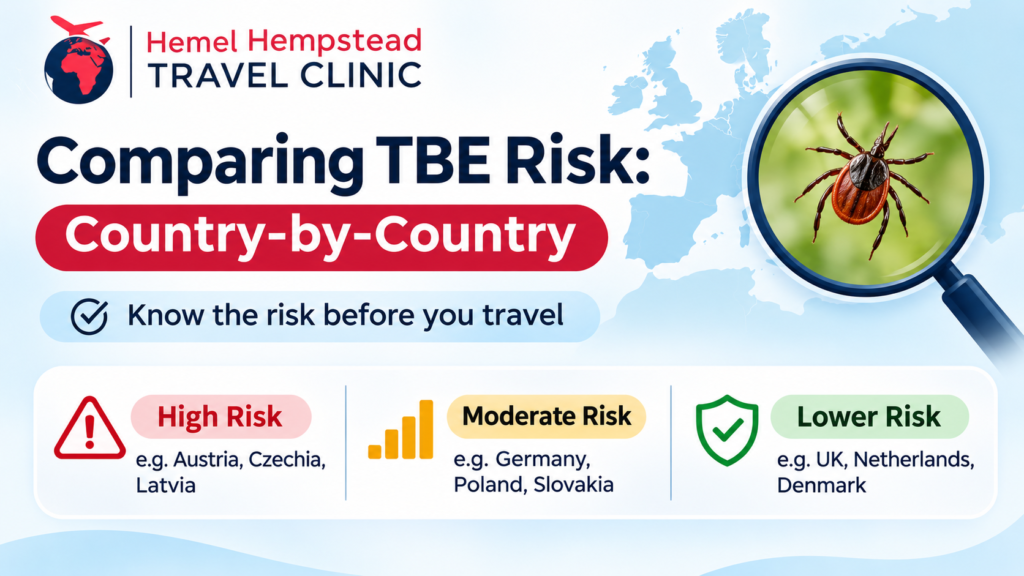
TBE risk by country varies considerably across Europe and northern Asia. Estonia, Latvia, Lithuania and Slovenia have reported some of Europe’s higher incidence rates, while Austria, Germany, Switzerland, Sweden, Poland and other countries contain important regional hotspots. Your actual risk depends on the exact area, season and outdoor activities planned.
Introduction
Tick-borne encephalitis, or TBE, is a viral infection mainly spread through infected tick bites. It occurs in focal areas stretching from western and northern Europe to northern and eastern Asia.
Understanding TBE risk by country is useful, but country names alone do not tell the whole story. One region may have established transmission while another part of the same country has little recognised risk.
Travellers from Hemel Hempstead planning hiking, camping or rural trips can discuss their itinerary with Hemel Hempstead Travel Clinic before deciding whether TBE vaccination is appropriate.
Key Takeaways
- TBE occurs in parts of Europe and northern Asia.
- The Baltic states report comparatively high TBE incidence.
- Slovenia and parts of central Europe are important risk areas.
- Germany’s highest-risk areas are mainly in the south.
- Italy’s risk is concentrated mainly in northeastern alpine regions.
- Risk is higher during outdoor activities in wooded and grassy areas.
- The main European transmission season is generally spring to autumn.
- Vaccination decisions should consider region, season and activities.
What Is Tick-Borne Encephalitis?
TBE is a viral infection that can affect the brain and central nervous system.
Most infections cause no symptoms, but some people develop a flu-like illness followed by meningitis or encephalitis.
There is no specific antiviral treatment for TBE.
Prevention therefore focuses on avoiding tick bites and considering vaccination when travel creates meaningful exposure.
Which Countries Have the Highest TBE Risk?
The Baltic states, Slovenia and some parts of central Europe have reported some of Europe’s highest TBE incidence, but this does not create a simple traveller-risk ranking.
CDC guidance identifies Estonia, Latvia, Lithuania, the Czech Republic and Slovenia among countries that have reported relatively high incidence in recent years.
Russia also reports large numbers of TBE cases because transmission occurs across extensive areas.
However, traveller risk depends more on where you actually spend time and what you do there.
TBE Risk by Country at a Glance
TBE risk is usually regional rather than uniform across an entire country.
Country | Main Reported Risk Areas |
Estonia | Widespread; greatest risk reported in western areas |
Latvia | Widespread; higher risk in western and central regions |
Lithuania | Widespread transmission |
Slovenia | Widespread; higher incidence in northern and central areas |
Austria | Many regions, including Carinthia, Styria and Tyrol |
Germany | Mainly Bavaria and Baden-Württemberg, plus other focal areas |
Switzerland | Most of the country except Ticino |
Sweden | Stockholm region and several southern/central areas |
Finland | Mainly southern coastal and archipelago areas |
Poland | Higher around Podlaskie and Warmian-Masurian regions |
Italy | Mainly northeastern Alpine and pre-Alpine areas |
France | Mainly Alsace and Auvergne-Rhône-Alpes |
Norway | Mainly southern coastal areas |
Denmark | Mainly Bornholm |
Russia | Widespread, particularly Siberia and the southern Urals |
This table shows recognised patterns, not a guarantee that every forest within those areas carries the same risk.
What Is the TBE Risk in Estonia?
Estonia is one of the European countries with consistently high reported TBE incidence.
Transmission areas occur throughout the country.
Current CDC information identifies western Estonia as having particularly notable risk.
Travellers hiking, camping or spending long periods outdoors during warmer months should therefore consider TBE exposure when planning their trip.
Is Latvia a High-Risk TBE Country?
Latvia has widespread TBE transmission and regularly reports relatively high incidence.
Risk occurs throughout the country.
The Kurzeme region in western Latvia and parts of Vidzeme and the Riga region have been identified as important risk areas.
Outdoor travellers should combine tick avoidance with a pre-travel assessment regarding vaccination.
What Is the TBE Risk in Lithuania?
Lithuania is also among Europe’s better-established TBE-endemic countries.
Transmission foci occur widely across Lithuania.
A traveller spending significant time hiking, cycling, camping or working outdoors during tick season has a different risk from someone making a short city visit.
This distinction is important when deciding whether vaccination is worthwhile.
Is Slovenia a TBE Risk Area?
Yes. TBE transmission occurs throughout Slovenia, with higher incidence reported in northern and central parts.
Slovenia is another European country that has regularly reported comparatively high disease incidence.
Its forests, mountain areas and outdoor tourism make exposure particularly relevant for hikers and campers.
Short urban tourism generally carries a much lower risk.
How High Is TBE Risk in Austria?
Austria has many recognised TBE transmission areas.
Highly endemic regions include Carinthia, Styria, Upper Austria, Salzburg, Tyrol and Vorarlberg.
However, focal transmission can occur elsewhere in the country too.
People travelling for Alpine hiking, camping or extended countryside stays should include TBE in their travel-health assessment.
Where Is TBE Risk Highest in Germany?
Germany’s main TBE risk is concentrated in the south.
Around 80–90% of reported German cases occur in Bavaria and Baden-Württemberg according to current CDC information.
Additional recognised risk areas include parts of Hesse, Thuringia, Brandenburg, Saxony and other localised districts.
A city break to Berlin is therefore not equivalent to several weeks hiking through southern German woodland.
Does Switzerland Have TBE Risk?
Yes. TBE risk is recognised across most of Switzerland, with Ticino currently the main exception.
Higher-risk areas occur in northeastern, central and midwestern parts of the country.
Thurgau has been identified as highly endemic.
Outdoor holidays involving hiking, mountain biking or camping may therefore warrant discussion about TBE vaccination.
What Is the TBE Risk in Sweden?
Sweden has established TBE risk, particularly around Stockholm and several southern and central regions.
Important areas include the Stockholm Archipelago, Lake Mälaren, Uppsala and Södermanland.
Other foci occur around lakes such as Vänern and Vättern.
Risk depends heavily on outdoor exposure rather than simply entering Sweden.
Does Finland Have TBE?
Yes, but Finland’s recognised risk is highly localised.
Important areas include parts of the southern coast and archipelagos, including Åland, Pargas and Kustavi.
Several additional municipalities have locally recognised risk.
This is a good example of why TBE risk by country needs to be assessed at regional level.
What Is the Risk in Poland?
Poland has TBE transmission, with higher numbers reported in the northeast.
Podlaskie and Warmian-Masurian provinces are particularly recognised.
However, transmission foci have been detected elsewhere.
Travellers planning forest walks, camping or lake-region holidays should check their exact route.
Is TBE a Risk in Italy?
Yes, particularly in northeastern Italy.
Risk is concentrated mainly in Alpine and pre-Alpine areas.
Important regions include Veneto, particularly the Belluno Alps, Friuli-Venezia Giulia and Trentino-South Tyrol.
TravelHealthPro reported 48 Italian TBE cases in 2025, including 45 locally acquired cases.
Does France Have TBE?
Yes, although recognised transmission is more localised than in several central and eastern European countries.
The main areas currently identified are Alsace and the Auvergne-Rhône-Alpes region.
Sporadic cases have also occurred elsewhere.
Travellers should therefore assess their exact rural destination rather than treating France as uniformly high or low risk.
What About Norway and Denmark?
Both countries have recognised TBE areas, but transmission is geographically limited.
In Norway, endemic areas are mainly along the southern coast, including Agder, Vestfold and Telemark.
In Denmark, established endemic transmission is mainly associated with Bornholm.
Very rare cases have also been reported from other local focal areas in Denmark.
How Significant Is TBE Risk in Russia?
Russia has extensive TBE-endemic territory and reports more cases than any other country.
Higher transmission has been reported in southern parts of western and eastern Siberia and the southern Urals.
The vast size of Russia means risk varies greatly by itinerary.
Travellers planning rural or forest travel should seek destination-specific advice.
Does TBE Occur Outside Europe?
Yes. TBE also occurs across parts of northern and eastern Asia.
Recognised areas include parts of Kazakhstan and Mongolia.
Sporadic infections have been reported in Hokkaido, Japan.
TBE virus has also been detected in ticks and animals in South Korea, although human cases have not been reported there according to current CDC information.
Does the UK Now Have TBE?
Yes, locally acquired TBE has now been reported in the UK, but the overall risk remains very low.
TravelHealthPro reported 10 locally acquired confirmed or probable cases as of 17 August 2026.
Reported regions included Devon, Hampshire, the Outer Hebrides, Scottish Highlands and Yorkshire.
TravelHealthPro continues to classify the risk as very low for the general UK population.
Routine TBE vaccination is therefore not recommended simply because someone lives in Britain.
Higher-Incidence Countries vs Localised Risk Countries
A country with widespread transmission requires a different interpretation from one with only small focal risk areas.
Widespread / Higher Reported Incidence | More Localised Recognised Risk |
Estonia | France |
Latvia | Denmark |
Lithuania | Norway |
Slovenia | Finland |
Parts of Russia | Italy |
Czech Republic | Japan |
This is not an official ranking.
Reporting methods, local vaccination programmes and surveillance quality can all affect national case numbers.
When Is TBE Risk Highest?
In Europe, TBE risk generally increases from early spring through late autumn.
CDC describes the main transmission season as approximately April to November.
Peak transmission often occurs during warm, humid summer months, particularly June to August.
However, season length varies with climate, altitude and local conditions.
Which Activities Increase TBE Risk?
Activities that bring you into forests, grassland and woodland edges increase exposure to infected ticks.
Higher-risk activities include:
- Hiking
- Camping
- Cycling
- Hunting
- Fishing
- Birdwatching
- Forestry or fieldwork
Short trips spent mainly in cities generally carry much lower risk.
Does Altitude Eliminate TBE Risk?
No. TBE transmission has expanded to higher elevations.
CDC reports that recognised transmission has been identified at elevations of around 2,100 metres.
Mountain holidays therefore should not automatically be considered risk-free.
The specific destination and local ecology still matter.
Can TBE Spread Without a Tick Bite?
Rarely, TBE can be acquired through unpasteurised dairy products.
Cases have been linked to raw milk or cheese from infected goats, sheep or cows.
Travellers in recognised TBE areas should avoid unpasteurised dairy products.
Most cases, however, are still caused by infected tick bites.
Who Should Consider the TBE Vaccine?
Vaccination should be considered when a traveller is likely to have meaningful outdoor exposure in a TBE-risk area.
TravelHealthPro recommends considering vaccination for travellers at risk and people working in affected rural areas.
Farmers, forestry workers and others with occupational exposure may be particularly relevant.
A short city break without rural activities usually carries much lower risk.
What Is the UK TBE Vaccine Schedule?
The UK uses TicoVac for adults and TicoVac Junior for children where vaccination is appropriate.
The standard schedule uses three doses.
The second dose is normally given 1–3 months after the first.
The third dose follows 5–12 months after the second dose.
When travel is approaching, the second dose can be given two weeks after the first.
TravelHealthPro states that the first two doses provide over 90% protection for the current tick season.
Does Vaccination Replace Tick Prevention?
No. Tick avoidance remains important after vaccination.
The TBE vaccine does not protect against Lyme disease or other tick-borne infections.
Wear suitable covering clothing when walking through wooded or grassy areas.
Use effective insect repellent and check your skin and clothing after outdoor activities.
Remove attached ticks promptly using fine-tipped tweezers or an appropriate tick-removal tool.
What Are Common Mistakes Travellers Make?
The biggest mistake is judging TBE risk only by country name.
A traveller hiking in Bavaria has a different exposure from someone spending a weekend in central Berlin.
Another mistake is assuming all European forest trips have the same risk.
Season, exact region, duration and activities all matter.
Common Misconceptions
All of Europe is a TBE risk area
No. Risk is concentrated in particular countries and focal regions.
Baltic countries are the only places with TBE
No. TBE occurs across many parts of central, northern and eastern Europe and northern Asia.
City travellers need the TBE vaccine
Usually not for short urban-only trips unless their itinerary includes risk areas or significant outdoor exposure.
TBE vaccine prevents Lyme disease
No. TBE and Lyme disease are different infections.
Removing a tick immediately guarantees you cannot get TBE
No. Prompt removal is still important, but TBE virus transmission can occur relatively quickly after attachment.
How Can Hemel Hempstead Travel Clinic Help?
Hemel Hempstead Travel Clinic can assess your personal TBE risk based on country, region, season and activities.
The clinic offers Tick-Borne Encephalitis vaccination using standard or accelerated schedules where appropriate.
Travel advice can also cover tick avoidance and other vaccines needed for your trip.
Hemel Hempstead Travel Clinic
49A St John’s Road
Boxmoor
Hemel Hempstead
If your itinerary includes hiking, camping, cycling or outdoor work in a TBE region, arrange a travel-health assessment before departure.
People Also Ask
Which countries have the highest TBE risk?
Estonia, Latvia, Lithuania, Slovenia and the Czech Republic have reported comparatively high incidence, while risk also exists in many other European and Asian regions.
Is TBE common in Germany?
It is mainly concentrated in southern Germany, especially Bavaria and Baden-Württemberg.
Is Austria a TBE risk country?
Yes. Several Austrian regions have established transmission.
Is Switzerland a TBE risk area?
Yes. Risk is recognised across most of Switzerland except Ticino.
Does Italy have TBE?
Yes. Risk is mainly concentrated in northeastern Alpine and pre-Alpine regions.
Is TBE present in the UK?
Yes, locally acquired cases have been reported, but the general population risk remains very low.
Conclusion
TBE risk by country varies considerably and is often highly regional.
The Baltic states and parts of central Europe report important transmission, but your exact route and outdoor activities matter more than the country name alone. Check your itinerary before deciding whether TBE vaccination is appropriate.
Frequently Asked Questions
It occurs across parts of Europe and northern and eastern Asia.
Usually from spring to autumn, with most transmission between April and November.
Yes. Hiking through woodland or grassland in affected areas increases tick exposure.
Usually not if they remain in urban areas and have little tick exposure.
Yes. TicoVac Junior is available for children over one year and under 16 when vaccination is recommended.
No. Tick-bite precautions remain necessary.
The full standard course contains three doses.
Hemel Hempstead Travel Clinic provides TBE vaccination at 49A St John’s Road, Boxmoor.