


Protecting Pilgrims on Their Sacred Journey
Every year, millions of Muslims from around the world travel to Saudi Arabia to perform Hajj and Umrah. For many, it is the most important journey of their lives, a spiritual pilgrimage filled with devotion, reflection, and community. However, amidst the spiritual significance lies a critical health concern that every pilgrim must prepare for—Meningitis.
The Saudi Arabian government requires proof of meningitis vaccination for all pilgrims before they are allowed entry, and for good reason. The Hajj pilgrimage is one of the largest mass gatherings in the world, where millions of people from diverse regions, climates, and health backgrounds come together in close quarters. This creates the perfect environment for infectious diseases to spread.
At Hemel Hempstead Travel Clinic, we regularly assist pilgrims preparing for Hajj and Umrah, ensuring they meet all health and vaccination requirements before travel. In this article, we’ll explore why the meningitis vaccine is so important, how meningitis spreads, the different vaccine options available, and why timely vaccination is crucial for safe and healthy pilgrimage.
What Is Meningitis?
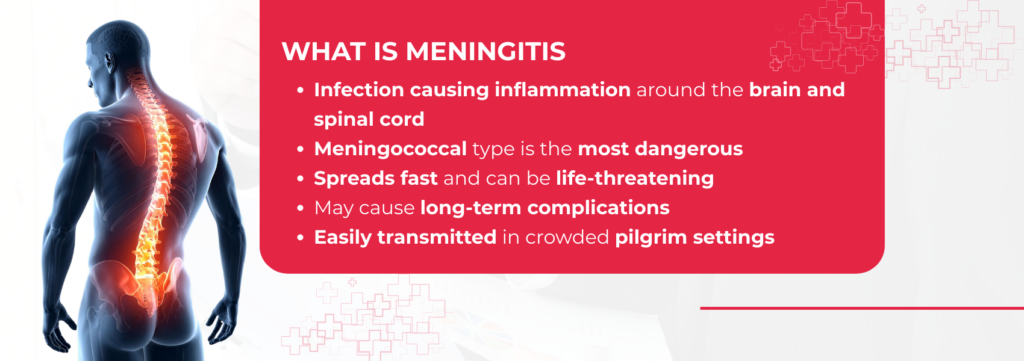
Meningitis is an infection that causes inflammation of the protective membranes covering the brain and spinal cord, known as the meninges. It can be caused by viruses, bacteria, fungi, or parasites, but meningococcal meningitis—caused by the bacterium Neisseria meningitidis—is the type of greatest concern for Hajj and Umrah pilgrims.
Bacterial meningitis is particularly dangerous because it can progress rapidly and lead to severe complications or even death if untreated. Survivors may face long-term health issues such as hearing loss, neurological damage, or seizures.
Unlike many other infections, meningitis spreads easily through close contact, making environments like pilgrimage gatherings especially high-risk.
How Does Meningitis Spread During Hajj and Umrah?

During Hajj and Umrah, millions of pilgrims gather in Mecca and Medina, sharing accommodation, food, and worship spaces. This creates several risk factors for meningitis transmission:
- Crowded conditions– Pilgrims sleep in shared tents, travel on buses together, and pray shoulder-to-shoulder with others from around the world.
- Prolonged close contact– Meningitis spreads through respiratory droplets (coughing, sneezing, kissing, or sharing utensils). Close proximity makes transmission much easier.
- Diverse global population– Pilgrims come from countries where different strains of meningitis may be more common, increasing exposure risks.
- Fatigue and lowered immunity– The physically demanding pilgrimage, combined with heat, stress, and long hours, can weaken the immune system and make travellers more susceptible.
This is why Saudi Arabia has made meningitis vaccination mandatory for all pilgrims—to reduce the risk of an outbreak during and after the pilgrimage.
Global and Local Prevalence of Meningitis
Meningitis is a global health concern, with the World Health Organization (WHO) noting outbreaks in regions such as Africa’s “meningitis belt” (stretching from Senegal to Ethiopia). Mass gatherings like Hajj have historically been associated with meningitis outbreaks.
For example, in the 1980s and 2000s, several meningitis outbreaks were linked to pilgrims returning from Hajj, spreading the infection across multiple countries. These events prompted Saudi authorities to enforce strict vaccination rules for all pilgrims.
In the UK, meningitis cases are rare, but when contracted abroad, travellers can bring it back home, putting families and communities at risk. At Hemel Hempstead Travel Clinic, we emphasise prevention—not only to protect the individual pilgrim but also their loved ones after returning.
The Importance of the Meningitis Vaccine for Pilgrims
The meningitis vaccine is not just a travel formality—it is a lifesaving precaution. By getting vaccinated before Hajj or Umrah, you:
- Protect yourself from a potentially fatal infection.
- Prevent transmission to fellow pilgrims.
- Avoid complications that could disrupt your pilgrimage.
- Comply with Saudi Arabian entry requirements (a certificate of vaccination is mandatory).
The vaccine certificate is checked by Saudi authorities before issuing a Hajj or Umrah visa, meaning without it, your travel plans could be cancelled or delayed.
Types of Meningitis Vaccines for Hajj and Umrah
For Hajj and Umrah, Saudi regulations specifically require the quadrivalent meningococcal vaccine (MenACWY), which protects against four major strains of the disease: A, C, W, and Y.
There are two main forms:
- MenACWY Conjugate Vaccine– Preferred option. Provides longer-lasting immunity (around 5 years) and is widely used in the UK.
- MenACWY Polysaccharide Vaccine– Provides shorter protection (around 3 years) and is less commonly used now.
At Hemel Hempstead Travel Clinic, we provide the conjugate MenACWY vaccine, ensuring compliance with Saudi requirements and offering stronger protection.
When Should You Get Vaccinated?
Pilgrims should aim to receive the vaccine at least 2–3 weeks before travel. This ensures that your body has enough time to build strong immunity.
Saudi Arabia requires proof that the vaccine was given at least 10 days before arrival and not more than 3–5 years old, depending on the vaccine type.
Booking early at Hemel Hempstead Travel Clinic not only secures your vaccination certificate but also gives you peace of mind as you prepare for your spiritual journey.
What to Expect at Your Appointment
When you book a meningitis vaccination at Hemel Hempstead Travel Clinic, the process is simple and reassuring:
- A consultation with a travel health specialist.
- Review of your travel itinerary and health history.
- Administration of the MenACWY vaccine.
- Issuance of an official vaccination certificate, required for your Hajj or Umrah visa.
- Additional travel health advice on other recommended vaccines (e.g., Hepatitis A, Typhoid, Flu).
This holistic approach ensures you’re fully protected, not just against meningitis but also other risks associated with travel to Saudi Arabia.
Additional Travel Health Considerations for Pilgrims
While the meningitis vaccine is mandatory, other vaccines and precautions are strongly recommended for Hajj and Umrah pilgrims:
- Seasonal flu vaccine– Crowded gatherings make flu transmission highly likely.
- Hepatitis A and B– Spread through contaminated food, water, or close contact.
- Typhoid vaccine– Especially important for long stays or rural travel.
- Covid-19 protection– Keeping up to date with boosters can reduce risks.
At Hemel Hempstead Travel Clinic, our specialists will guide you on the full range of vaccines and preventive measures suited to your personal health and pilgrimage plans.
Common Myths About the Meningitis Vaccine
Despite clear evidence of its benefits, some misconceptions about meningitis vaccination persist. Let’s address them:
- “I’m healthy, so I don’t need the vaccine.”
Even healthy people can carry and spread meningitis. Vaccination is essential regardless of your health status. - “I already had meningitis years ago, so I’m immune.”
Previous infection does not provide lifelong protection. The vaccine is still required. - “The vaccine has serious side effects.”
The MenACWY vaccine is very safe. Most people experience only mild soreness at the injection site.
“I can get vaccinated when I arrive in Saudi Arabia.”
Saudi authorities require proof of vaccination before visa approval. You must be vaccinated before travel.
Why Choose Hemel Hempstead Travel Clinic for Your Hajj/Umrah Vaccination?
Preparing for Hajj or Umrah can be overwhelming, with travel arrangements, visa applications, and spiritual preparations to consider. The last thing you need is uncertainty about health requirements.
By choosing Hemel Hempstead Travel Clinic, you benefit from:
- Convenient local appointments.
- Experienced staff familiar with Saudi entry requirements.
- Immediate issuance of official vaccination certificates.
- A comprehensive travel health consultation, ensuring no important detail is missed.
We make the process smooth and stress-free, allowing you to focus on the spiritual aspects of your pilgrimage.
Final Thoughts – Safe Pilgrimage, Peace of Mind
Performing Hajj or Umrah is one of the greatest journeys in a Muslim’s life, and protecting your health is an essential part of that preparation. The meningitis vaccine is more than just a requirement—it’s a vital safeguard for you, your fellow pilgrims, and your loved ones back home.
At Hemel Hempstead Travel Clinic, we are here to guide and support you every step of the way, from vaccination to travel health advice, ensuring your pilgrimage is safe, smooth, and spiritually fulfilling.
FAQs About Meningitis Vaccination for Hajj and Umrah
Yes. All pilgrims must show proof of the MenACWY vaccine to obtain a Saudi visa.
The conjugate MenACWY vaccine provides protection for about 5 years.
Yes. The vaccine can be given to children as young as 2 years old. Infants may require specialist advice.
Most people experience mild side effects, such as soreness at the injection site or a low-grade fever, which resolve quickly.
Yes. At Hemel Hempstead Travel Clinic, we often administer meningitis vaccines alongside Hepatitis A, Typhoid, or flu vaccines, depending on your needs.
At least 2–3 weeks before your planned departure, but you must allow a minimum of 10 days before entry into Saudi Arabia.