
Quick Answer
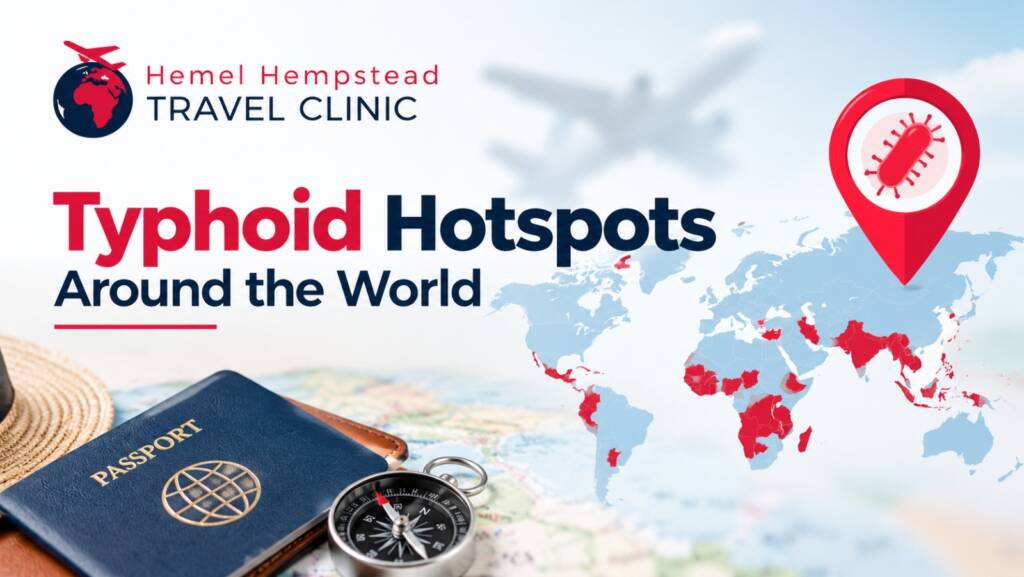
Typhoid hotspots around the world are mainly found in South Asia, parts of Southeast Asia, Africa and some areas of Central and South America. Risk is higher where sanitation and access to clean drinking water are limited. Travellers can reduce their risk through vaccination, safe food and water choices and good hand hygiene.
Introduction
Typhoid fever remains an important travel-health risk in many parts of the world.
The infection is caused by Salmonella Typhi bacteria and mainly spreads through contaminated food or water.
The risk is not the same everywhere. It is higher in places where sanitation, clean water and food hygiene may be less reliable.
Understanding the main typhoid hotspots around the world can help travellers decide when vaccination and extra precautions may be important.
For UK travellers, South Asia remains especially significant. However, typhoid also occurs in parts of Africa, Southeast Asia and Central and South America.
Hemel Hempstead Travel Clinic in Boxmoor provides typhoid vaccination and personalised travel-health advice based on your destination and itinerary.
Key Takeaways
- South Asia carries one of the highest global typhoid burdens.
- Typhoid also occurs in parts of Africa and Southeast Asia.
- Central and South America have some risk areas.
- Risk is higher where sanitation and clean water are limited.
- Visiting friends and relatives can increase exposure.
- Vaccination reduces risk but does not provide complete protection.
- Safe food and water remain essential after vaccination.
- Country-specific advice should always be checked before travel.
What Is Typhoid Fever?
Typhoid fever is a bacterial infection caused by Salmonella Typhi.
It mainly spreads when food or drinking water becomes contaminated with faecal material from an infected person or carrier.
Typhoid and paratyphoid are sometimes grouped together as enteric fever because they cause similar illnesses.
Paratyphoid is caused by Salmonella Paratyphi.
Current typhoid vaccines protect against typhoid but do not reliably protect against paratyphoid.
This is why good food and water hygiene remains important even after vaccination.
Where Are the Main Typhoid Hotspots?
The greatest typhoid burden is concentrated in South Asia and parts of sub-Saharan Africa, although significant risk also exists elsewhere.
South Asia is particularly important for UK travellers.
Recent UK surveillance shows that many travel-associated enteric fever cases are linked with visits to India, Pakistan and Bangladesh.
This does not mean that risk is limited to these countries.
Typhoid also remains present in parts of Southeast Asia, Africa, the Middle East and Central and South America.
Region | General Typhoid Concern |
South Asia | Very high importance |
Southeast Asia | Risk in several destinations |
Sub-Saharan Africa | Significant risk |
North Africa & Middle East | Variable |
Central America | Risk in some areas |
South America | Variable |
Europe | Generally much lower |
North America | Generally low |
Australia & New Zealand | Generally low |
This table is only a broad guide.
Always check advice for your exact destination before travelling.
Why Is South Asia Such an Important Risk Region?
South Asia carries a particularly high burden of typhoid and is strongly represented in UK travel-associated cases.
The region includes destinations frequently visited by UK residents for holidays, business and family visits.
Travellers visiting friends and relatives can sometimes underestimate their risk because they are familiar with the area.
However, previous travel or family connections do not provide reliable protection against typhoid.
Longer stays, local food and frequent contact with local communities can increase exposure.
Vaccination and food hygiene are therefore especially important for travellers to higher-risk parts of South Asia.
What About Africa and Southeast Asia?
Typhoid remains a concern across many parts of Africa and several Southeast Asian destinations.
Risk is higher where safe drinking water, sanitation and food hygiene may be inconsistent.
Travellers staying in rural areas, local accommodation or smaller communities may face greater exposure.
Backpackers, volunteers and long-stay travellers may also be at increased risk because they have more opportunities to encounter contaminated food or water.
However, staying in a high-quality hotel does not completely remove the risk.
Exposure can still occur in restaurants, markets, excursions or when drinking unsafe water.
Is Typhoid a Risk in Central and South America?
Yes, typhoid occurs in parts of Central and South America, although risk varies between locations.
Some countries have improved sanitation and lower transmission than in the past.
However, travellers visiting rural areas or places with limited access to clean water may still face risk.
Longer stays and local food exposure can also increase the chance of infection.
For this reason, vaccination recommendations should be based on the exact destination rather than the continent alone.
Is Typhoid Common in Europe or North America?
Typhoid is generally uncommon in Europe, North America, Australia and New Zealand.
Most cases diagnosed in the UK are linked to overseas travel rather than infection acquired locally.
However, outbreaks can occur anywhere.
Travellers visiting several destinations on the same trip should base their preparation on the highest-risk part of the itinerary.
For example, a journey may begin in a low-risk country but continue into an area where typhoid vaccination is recommended.
Who Is Most at Risk While Travelling?
Travellers who have more contact with local food, water or sanitation conditions may face a greater risk.
Higher-risk groups can include:
- People visiting friends and relatives
- Long-stay travellers
- Backpackers
- Aid workers
- Adventure travellers
- People staying in rural areas
- Travellers visiting places with unreliable water supplies
- People eating frequently from local food vendors
Trip length also matters.
A longer stay usually creates more opportunities for exposure, but even a short trip can carry risk if contaminated food or water is consumed.
How Does Typhoid Spread?
Typhoid mainly spreads through contaminated food and water.
An infected person can pass Salmonella Typhi bacteria in their faeces.
Poor handwashing or sanitation can then allow the bacteria to contaminate food, drinking water or surfaces.
Travellers may be exposed through unsafe tap water, ice, raw produce or food prepared under poor hygiene conditions.
Food can look completely normal and still be contaminated.
This is why appearance alone is not enough to judge whether food is safe.
What Are the Main Symptoms?
Typhoid commonly causes a persistent fever along with general and digestive symptoms.
Symptoms may include:
- High temperature
- Headache
- Tiredness
- Weakness
- Abdominal discomfort
- Loss of appetite
- Constipation
- Diarrhoea
- Muscle aches
Symptoms usually develop within a few weeks of infection.
If you become unwell during or after travel, tell the healthcare professional exactly where you have been.
This can help them consider travel-related infections more quickly.
Why Can Typhoid Become Serious?
Untreated typhoid can cause serious complications.
Most people recover with appropriate antibiotics.
However, severe infection can lead to intestinal bleeding or perforation.
Antibiotic resistance is also becoming increasingly important in some regions.
This can make treatment more complicated.
For this reason, suspected typhoid should be medically assessed rather than treated as ordinary traveller’s diarrhoea.
How Can Travellers Prevent Typhoid?
The best protection combines vaccination with careful food, water and hand hygiene.
Vaccination can significantly reduce your risk.
However, it does not provide complete protection.
Travellers should still wash their hands regularly, particularly before eating and after using the toilet.
Where tap water is unsafe, choose sealed bottled or appropriately treated water.
Be cautious with ice, raw shellfish, unpasteurised dairy products and raw foods washed with unsafe water.
Freshly cooked food served piping hot is generally a safer choice.
Vaccination vs Food and Water Precautions
Vaccination and safe food practices work best together.
Typhoid Vaccination | Food & Water Precautions |
Reduces typhoid risk | Reduces exposure |
Recommended for some travellers | Important for all travellers in risk areas |
Does not provide 100% protection | Also reduces other stomach infections |
Does not reliably prevent paratyphoid | Helps reduce typhoid and paratyphoid risk |
May require boosters | Needed throughout the trip |
Neither approach should replace the other.
When Should You Get the Typhoid Vaccine?
Arrange a travel-health assessment several weeks before departure whenever possible.
This gives enough time to review your itinerary and complete any recommended vaccinations.
However, last-minute travellers should still seek advice.
Depending on the vaccine and circumstances, protection may still be possible even when departure is close.
People who travel regularly to risk areas may need a booster after a certain period.
Bring previous vaccination records to your appointment if available.
Who Should Pay Particular Attention to Typhoid Risk?
Some travellers may need more careful preparation because their travel style increases exposure.
People visiting friends and relatives are particularly important.
These travellers may stay longer, eat more local food and spend more time outside tourist areas.
Backpackers, volunteers and people travelling through rural areas may also have higher exposure.
Business travellers can also be at risk if they eat frequently outside hotels or travel to several locations.
The important point is that typhoid risk depends on behaviour as well as destination.
What Are Common Typhoid Prevention Mistakes?
The biggest mistake is assuming vaccination removes the need for food and water precautions.
Another common mistake is thinking a short trip has no risk.
Typhoid infection can occur after a single exposure to contaminated food or water.
Travellers may also underestimate ice, salads and raw foods.
Another mistake is assuming that familiar destinations are automatically safe.
People visiting family abroad should follow the same precautions as any other traveller.
What Are Common Misconceptions?
“Typhoid only occurs in one or two countries.”
No. It occurs across several regions of Asia, Africa and Central and South America.
“Luxury hotels remove all risk.”
No. Exposure can still occur through restaurants, excursions or local food.
“The vaccine gives complete protection.”
No. Food and water hygiene remains essential.
“Short holidays are safe.”
Not necessarily. A single contaminated meal may be enough to cause infection.
“If I grew up in a high-risk country, I am still protected.”
Not necessarily. Previous residence does not guarantee lasting immunity.
What Do Recent UK Data Show?
Recent UK surveillance continues to show that travel-associated enteric fever is an important issue.
UKHSA reported hundreds of travel-related typhoid and paratyphoid cases in 2026.
South Asia remained especially important in reported travel histories.
Cases also tend to rise during periods when international travel increases.
This reinforces the importance of pre-travel vaccination checks rather than assuming typhoid is an outdated disease.
How Can Hemel Hempstead Travel Clinic Help?
Hemel Hempstead Travel Clinic can assess your typhoid risk based on your exact destination and travel plans.
The clinic provides typhoid vaccination alongside other travel-health services.
Your consultation can consider your destination, length of stay, accommodation, planned activities and previous vaccinations.
Advice can also cover safe food and water practices.
Hemel Hempstead Travel Clinic
49A St John’s Road
Boxmoor
Hemel Hempstead
If you are travelling through several countries, bring your full itinerary so each destination can be assessed properly.
People Also Ask
Where is typhoid most common?
Typhoid is particularly important in South Asia and also occurs in parts of Africa and Southeast Asia.
Is typhoid still common today?
Yes. Millions of cases continue to occur worldwide each year.
Can tourists get typhoid?
Yes. Travellers can become infected through contaminated food or water.
Does staying in a good hotel prevent typhoid?
No. It may reduce some exposure but cannot eliminate the risk completely.
Do I need a vaccine for a short trip?
Possibly. Vaccination depends on destination and activities rather than trip length alone.
Does typhoid vaccination protect against paratyphoid?
No. Current typhoid vaccines do not reliably protect against paratyphoid.
Conclusion
The main typhoid hotspots around the world are concentrated in South Asia, parts of Africa, Southeast Asia and some areas of Central and South America.
However, the exact destination is only part of the picture.
Your accommodation, travel duration, food choices and access to safe water all influence your individual risk.
Vaccination can provide valuable protection, but it should always be combined with good food, water and hand hygiene.
Before travelling to a typhoid-risk area, contact Hemel Hempstead Travel Clinic in Boxmoor for a personalised travel-health assessment and vaccination advice.
Frequently Asked Questions
South Asia carries one of the highest global burdens.
Typhoid remains a significant problem in many parts of Africa.
Yes. Risk exists in parts of Central and South America.Accordion Content
It is generally uncommon, and many UK cases are linked to overseas travel.
It mainly spreads through food or water contaminated with Salmonella Typhi.
No. Vaccination reduces risk but does not provide complete protection.
Yes. Antibiotics are used, although resistant strains can make treatment more difficult.
Hemel Hempstead Travel Clinic in Boxmoor provides typhoid vaccination and personalised travel-health advice.